Cancel it, or keep it? Decide from what you actually watched
Everybody has a subscription they are not sure about. The advice you get is either “cancel things you don’t use”, which you already knew, or a bank app that can see the charge and has no idea what you watched.
This gives you an answer instead: keep it, drop the tier, or cancel now and come back on the day the show you’re waiting for returns — worked out from your own episode history, with the money attached. The number underneath it all is what each service costs per hour you actually watched, and this page shows that arithmetic in full, because a verdict you can’t check is just another opinion.
The number nobody shows you
Two people pay Netflix the same $19.99. One watched 42 hours last month. The other watched one episode and forgot about it. They are paying $0.48 an hour and $19.99 an hour for exactly the same product, and neither of them has ever been told which one they are.
Every budgeting app in existence can tell you that $19.99 left your account. That is a bank statement, not an insight. The interesting question is what you got for it, and answering that needs something a bank never sees: what you actually watched.
A worked example
This is a screenshot of the actual Subscriptions tab, not a mock-up. Four services, a month of ordinary viewing, and the only figures typed in by hand are the prices. Two cards from the same screen; the ones in between are cut for length. Taken 9 August 2026 — the return date it names is relative to that day.
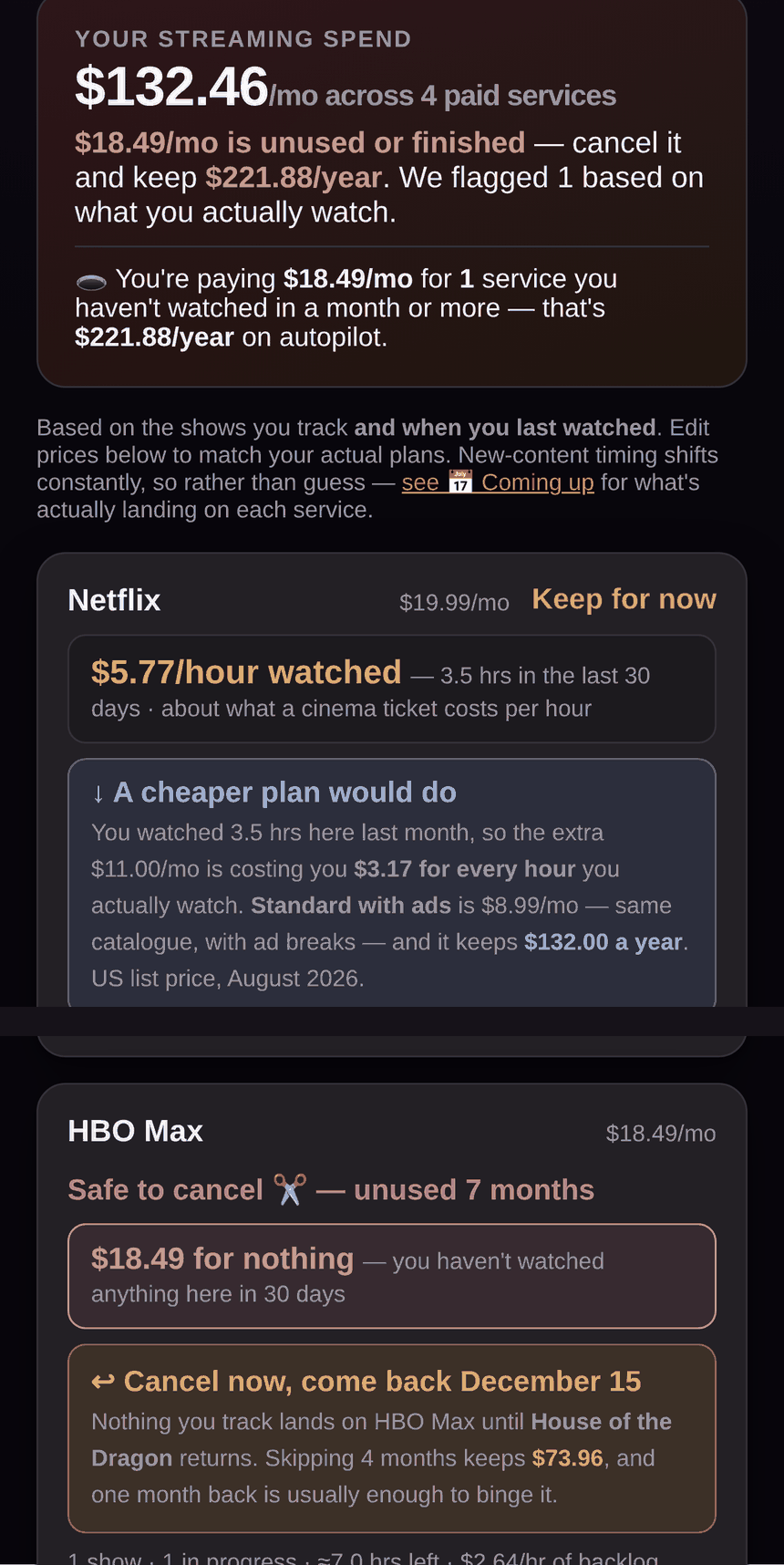
Prices are US list, August 2026, and every one is editable — set them to what you actually pay. The hours are not editable, because they come from your own watch history.
Where the hours come from
Every time you tick an episode, that tick is stamped with the moment and the episode's runtime. Thirty days of those ticks is a measured record of your viewing, per service, and it is the only honest denominator for this sum. It is worked out in your browser from your own data.
Three things it deliberately refuses to do, because each one was a bug before it was a rule:
- It will not call a service unused if you have never logged anything on it. Silence only means something if there was something to be silent about. A service with no history at all gets "we can't tell", not a verdict.
- It does not count an import as an evening's viewing. Restoring ten years of history in one afternoon is not forty hours of watching, and treating it as such made services look busy that nobody had opened in months.
- It does not count rating a show as watching it. Obvious in hindsight. It was not obvious at the time, and it made five taps look like three and a half hours.
Cancelling is usually not the best answer
A tool that can only say "keep" or "cancel" will tell you to cancel things you would miss. Two answers sit between them, and both are worth more than the blunt one.
A cheaper plan on the same service
If you watch three hours of ad-free Netflix a month, you are paying over three dollars an hour to avoid adverts you would barely have sat through. The ad tier is the same catalogue. That is $132 a year for nothing you can point at, and cancelling was never necessary to get it back. Where the cheaper plan is not the same catalogue — Peacock Select, Paramount+ Essential, YouTube TV's Entertainment plan are all genuinely smaller — it says so rather than pretending.
Cancel now, come back on a date
The reason people keep paying for a service they are not watching is the show that returns eventually. So the answer is the date. If nothing you track lands on HBO Max until December 15, four skipped months is $73.96 you keep, and one month back is usually enough to binge the season. That is not a nag, it is a diary entry with a price on it.
What this is not
It is not a budgeting app and it does not touch your bank. It never sees a card, an account or a transaction. The prices are ones you confirm; the viewing is one you recorded yourself by using a TV tracker for the ordinary reason people use one.
It is also not a subscription-cancelling service. It will not cancel anything on your behalf, take a cut of what you save, or ask for a fee to tell you the number. There is no paid tier at all.
Tick the services you pay for and you have your yearly total in about ten seconds, before you add a single show. Add what you watch and it starts working out which part of that total is earning its keep.
Open the free app →Runs in any browser. No sign-up needed to start. Export your data any time.
Common questions
Do I have to log everything for this to work?
No, but the more you log the sharper it gets, and it is honest about that. Until there is viewing to reason about, a service reads "we can't tell" rather than guessing — that is the point of the rule above.
What if I share subscriptions with someone?
You can sync with whoever else is on the bill. You each keep your own list, you both see what the other wants to watch, and neither of you pays twice for something nobody is using.
Can I bring my history from another tracker?
Yes. A TV Time export imports directly with dates preserved, and if you never saved one there is a rebuild path that does not need an export file — your streaming services' own records, a pasted list, or a TV Time iPhone backup. Trakt and Serializd users can keep using those and run this alongside.
What channel is the game on? Every team, every network →
Prices quoted are US list prices as of August 2026, gathered from Consumer Reports' streaming service guide, DealNews and the services' own pricing pages. Set yours to what you actually pay — the arithmetic uses your figure, not ours.
Home · Open the app · What should I cancel? · Streaming cost calculator · Free-trial tracker · Privacy · Terms